
Covington, GA · Garage Door Service
Roller Replacement for Oxford's Older Doors
Oxford homes built mostly in the late 1960s run steel rollers on short, straight track. We travel 2 miles from Covington to replace worn rollers before the track gets gouged.
- Repairs & new doors
- Springs & openers
- Serving 4 nearby communities
Parts We Carry
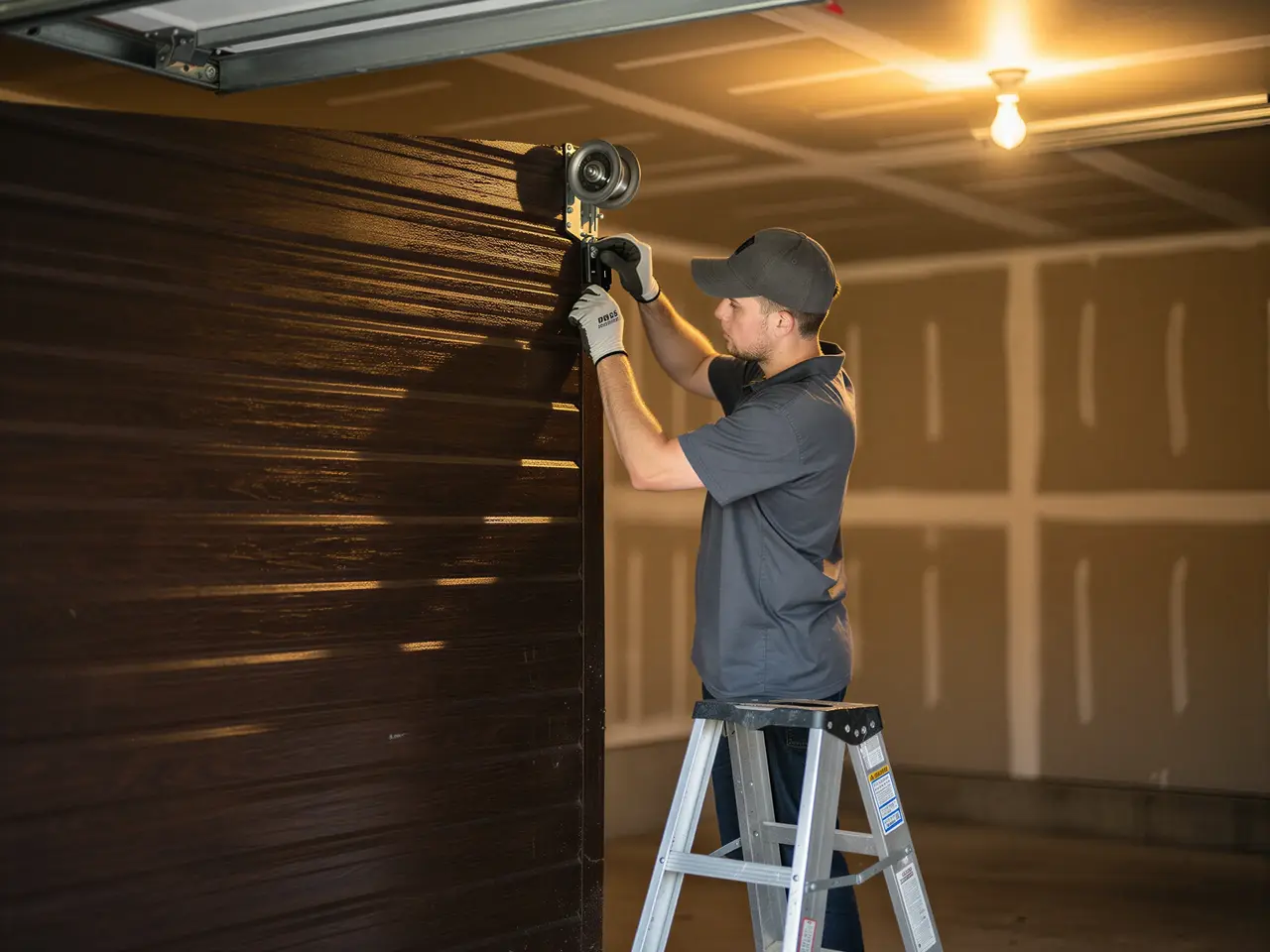
For a door going in on an Oxford job, we're usually working off a 1960s frame, not the wider 1980s-90s stock you see elsewhere in the service area. That means 7-ball or 10-ball steel rollers on shorter track radius, and the stem length has to match the original hinge spacing or the door won't travel straight. We carry sealed nylon rollers too, and for most Oxford houses we'll push nylon over steel once the old roller fails, because nylon doesn't need the lubrication steel does and it runs quieter on track that's had 50-plus years to pick up minor bends. We don't stock every stem length on the truck - if a door's track has been swapped at some point and the spacing is non-standard, that part may need a day to source. We'll tell you straight if that's the case rather than force a roller that's close enough. One limitation worth saying plainly: if the track itself is bent or the rollers have already chewed the inside edge, a roller swap alone won't fix the noise. At that point you're replacing a section of track, not just the part that rides in it.
What Causes It Around Here
The houses in Oxford are older than the median for the wider area - 1969 versus a service-area median closer to 1983 - which means more doors here are still running their second or third set of rollers, not their first. Steel rollers on a door that age have usually gone 15 to 20 years between swaps, long enough for the bearing to dry out and the roller to start binding on the track instead of rolling through it. That binding is what wears the inside groove of the track into a shallow trench, and once the trench is there, a new roller rides in that worn groove and starts making the same noise again. Cold mornings make it worse: a dry steel roller contracts slightly in a cold snap and the clearance tightens, so the grinding you hear in January is often the same roller that was just noisy, not broken, in July. That's a climate issue, not a defect, and it's one more reason nylon holds up better once a door's hardware is already decades old.
Doing It Yourself
Rollers are one of the few garage door parts a careful homeowner can replace without touching anything under spring tension, as long as you're working on the lower two rollers on each side and leaving the top ones - the ones nearest the spring assembly and the closing point of the track - alone. Pop the roller bracket, slide the old roller out, slide the new one in, and check that the door still tracks straight with the door open and resting on its stop. Where people get hurt is pulling a roller near the top of the track while the door is closed and the springs are still loaded, or trying to bend the track back into shape with the door half-open. If your rollers are the top set, or the track has a visible dent near where the trench has worn in, that's a call to make rather than a Saturday project. Given the age of hardware common in Oxford, we'd rather talk you through what you're looking at over the phone than have you force a part that doesn't fit the original spacing.
How Long You Are Without the Door
We travel from Covington, about 2 miles to most Oxford addresses, so getting a truck out isn't the long part of the job - the roller swap itself is. A straightforward set, all eight rollers on a double door, usually runs under an hour once we're on site and have confirmed the track isn't also bent. Where it runs longer is exactly the scenario above: a trench worn into the track from years of a dry or binding roller. In that case we're pulling a section of track as well, and that adds time because the door has to come off balance and get re-hung square. We won't guess at that before we see the door - a door that's been making noise for months is more likely to need the longer job than one that just started.
What the Fix Involves
We start by rolling the door up and down a few times to hear where the noise actually happens - at the curve near the top, along the flat run, or right at the floor - because that tells us which rollers are worn and whether the track has taken damage. Then we check the bracket bolts, since loose brackets can mimic a bad roller and cost you money if we replace a part that wasn't the problem. Rollers come out one at a time, lower set first, with the door supported and off the opener. Once new rollers are in, we run the door a dozen cycles and recheck the track alignment, because a door that rolled rough for years can have pulled the track slightly out of parallel even after the rollers are fixed. Last step is lubricating everything that still needs it - nylon rollers don't, steel ones do - and showing you what we found before we close out the job.
Frequently asked questions
Why do my rollers make more noise in winter?
Steel rollers contract slightly in cold weather, which tightens their clearance in the track. On older Oxford homes running original or second-generation hardware, that tighter clearance on a roller that's already a little dry shows up as grinding that wasn't there in summer. It's usually the same wear, just more noticeable in the cold.
Can I replace just the noisy roller or do I need all of them?
If only one or two rollers are worn, you can replace just those, but rollers on the same door usually wear at close to the same rate. We'll check the full set while we're there and tell you honestly which ones still have life left rather than replace parts that don't need it.
Is nylon better than steel for a house this age?
For a door built around 1969, yes, in most cases. Steel rollers need regular lubrication and wear faster once track has minor bends from decades of use. Nylon rollers run sealed and quieter, and they're more forgiving of the slight track irregularities common in older Oxford hardware.
Do you have a shop in Oxford?
No, we run out of Covington and travel to Oxford for jobs, about 2 miles. There's no separate branch or depot here - the same crew and truck that handle Covington calls handle Oxford ones.
Book garage door service in Covington
Call now or request a quote - tell us what the door is doing and where you are.