
Covington, GA · Garage Door Service
Is Your Old Covington Garage Door Worth Repairing
Most Covington garage doors date to the 1980s-90s. Here's how to tell if yours still earns a repair or needs replacing, given our cold winters and housing age.
- Repairs & new doors
- Springs & openers
- Serving 4 nearby communities
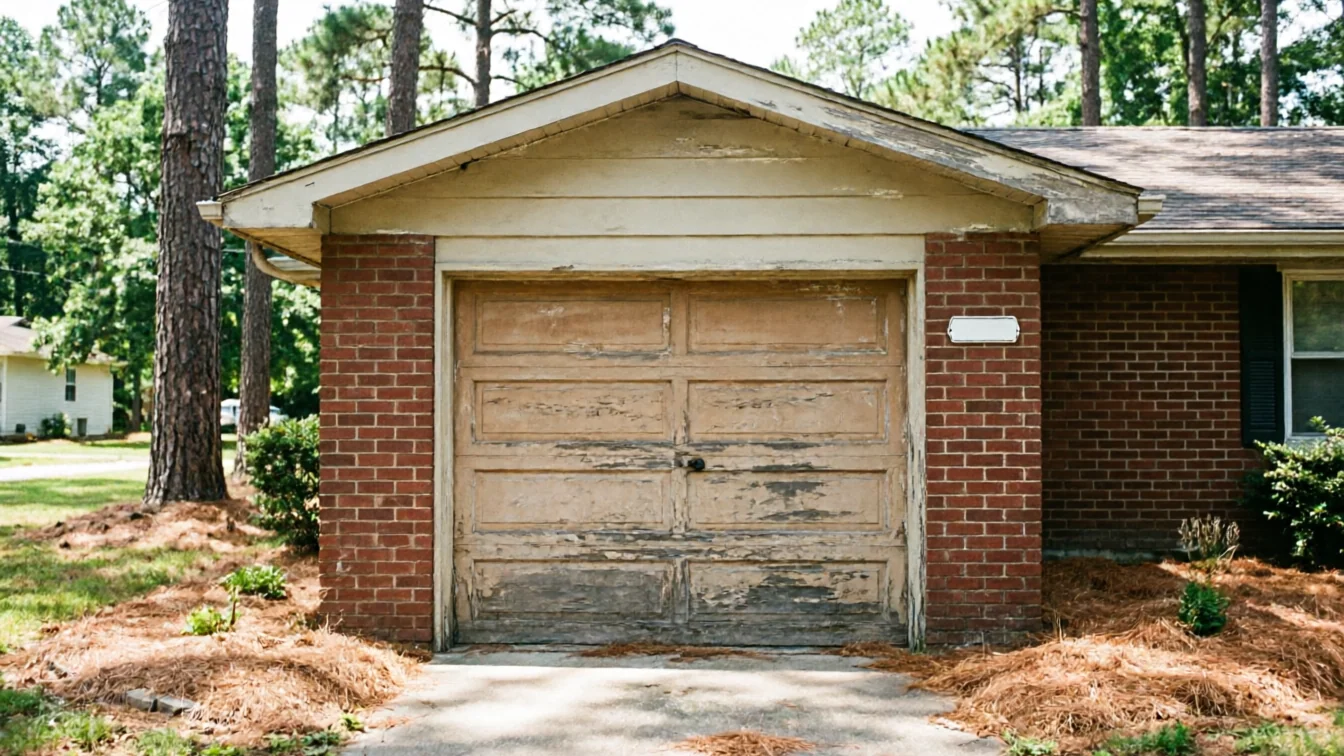
What the Weather Here Does to It
Covington sits in a cold moderate climate band, which means the door on your house isn't dealing with one hard freeze a year - it's cycling through freeze and thaw all winter long. That matters more here than it would somewhere milder, because most of the housing in this service area went up between 1938 and 2002, with the typical build year landing around 1983. A door that old wasn't built with today's sealed bottom astragals or insulated panels. Steel tracks contract in the cold and expand again once the sun hits them, and over thirty-plus winters that movement works the bolts loose and throws the track out of plumb. Torsion springs lose a little tension with every cycle, and a spring wound in 1985 has had a lot more cycles than one wound five years ago. Wood trim on older doors swells with humidity and shrinks when the heat kicks on, which is why so many doors from this era stick at the bottom corners in January and run fine by June. None of this means the door is junk. It means the hardware doing the work is original, or close to it, and original hardware from the 1980s was not built to last forever.
The Problem
Nine named areas in this service area are dominated by 1980s and 90s construction, and that generation of garage door is pretty consistent: single-layer steel panels, no foam insulation, galvanized torsion springs rated for a fixed number of cycles, and steel rollers instead of the nylon ones that came standard later. None of that is a defect - it's just what a builder put in thirty-some years ago. The trouble shows up as rust bubbling through the bottom panel where water sits, a spring that's gone quiet instead of making its normal sound, or an opener motor that strains and reverses on cold mornings. With a median household income of $58,594 across this area, most owners we talk to want a straight answer on repair versus replace, not an upsell. That's the honest tension on an older door: the steel skin and frame often outlast the springs, cables, and rollers inside them by decades, so you can end up replacing every moving part on a door that's structurally fine and come out well ahead of a new install.
What to Look At First
Start with the panels. Surface rust wipes off and isn't a problem; rust that's eaten through the metal, especially along the bottom panel where snowmelt and rain sit, means that panel is failing even if the rest of the door looks solid. Next, look at the track - stand back and sight down it on both sides. A track that's bowed or pulling away from the wall is a symptom of the door fighting itself for years, not a one-time knock. Check the springs by looking at the coil: heavy rust or a visible gap in the winding means it's near the end of its rated cycles. Weatherstripping matters more here than in a warmer climate - if the bottom seal is cracked or flattened, cold air and water are getting under the door all winter, which accelerates rust on everything above it. Last, listen to the opener. A motor that grinds, hesitates, or needs multiple tries on cold mornings is usually fighting worn springs or a dragging track, not failing on its own. Fixing the actual source usually solves the opener complaint too.
When Waiting Is Fine
Not everything on an old door needs attention this season. Cosmetic rust on the surface, a dent in a panel that doesn't affect the seal, or a slightly faded paint job on a door that still opens and closes square - none of that is urgent, and we'd rather tell you to leave it than sell you a panel swap you don't need. The same goes for a door that's loud but moving correctly; noise on an older door is often just worn roller bearings, and that's a small fix you can schedule rather than an emergency. Where we draw the line is anything tied to the spring or cable system, because those fail without much warning and a door that drops is a safety problem, not a convenience one. One honest limitation: panels for some older, discontinued profiles aren't something we stock, and ordering a single matching panel from this era can take longer than most people expect. If your door needs one odd panel rather than a full replacement, we'll tell you the real timeline before you commit to that route instead of a full door.
Frequently asked questions
My garage door is from the 1980s - is it too old to fix?
Age alone doesn't rule it out. What matters is the steel skin and frame, which often outlast the moving parts. If the panels aren't rusted through and the frame is square, replacing springs, cables, and rollers on a door from this era is usually cheaper than a full replacement and gets you years more use.
Why does my door stick in winter but not summer?
That's typically wood swelling, a weatherstrip gone stiff with cold, or a track that's slightly out of alignment and only binds once metal contracts. It's common on houses built in this area's 1980s-90s construction wave, since original hardware wasn't sealed the way newer doors are.
Is it worth replacing just one rusted panel?
Sometimes, but panel profiles from older doors aren't always stocked, and matching one can take longer than people expect. We'll check availability before recommending it - if the wait or cost gets close to a full door, we'll say so rather than string out a single-panel order.
How do I know if my spring is original?
We can't tell you an exact age without looking at the coil, but a spring that's visibly rusted deep into the winding, or one original to a house built decades ago, has almost certainly used up its rated cycles. A quiet spring that used to make noise when the door moved is often a sign it's near the end.
Related garage door services in Covington
More garage door guides
Book garage door service in Covington
Call now or request a quote - tell us what the door is doing and where you are.