Covington, GA · Garage Door Service
Garage Door Panel Replacement, Covington GA
Dented or cracked garage door panels are common on Covington's 1980s and 90s-built homes. We replace single panels or full sections to match your door style.
- Repairs & new doors
- Springs & openers
- Serving 4 nearby communities
Doing It Yourself
A single cracked or dented panel looks like a weekend fix, and sometimes it is. If your door is a current model from a major manufacturer and you can get the exact panel section, bolting one on isn't beyond a handy homeowner - the bolts along the stile are usually exposed, and the hinges unbolt the same way they went on.
Where it stops being a DIY job is matching. Panel profiles change by decade, by manufacturer, and sometimes by the year a specific model ran. Order the wrong rib spacing or the wrong panel height and it won't seat against the sections above and below it, so the door won't track straight. On older doors, the exact replacement may not be made anymore, and you're into either a custom panel order or swapping more sections than the one that's damaged just to get a visual match.
The other real risk is the spring system. If the damaged panel sits anywhere near the bottom bracket, you're working close to cables under tension, and that's not a place to learn on the job. We'll tell you straight when a repair is a bolt-on weekend job and when it isn't - we'd rather lose a small job than see someone get hurt on one.
What Causes It Around Here
Housing across this service area was mostly built between 1938 and 2002, with the median landing around 1983, and the bulk of it going up through the 1980s and 90s. That build era matters for panels in two ways. First, a lot of these doors are steel sandwich panels from a period when manufacturers used thinner gauge steel than they do now, so a bumper tap or a stray basketball leaves a dent that a newer door would shrug off. Second, wood and wood-composite panels from that same era are old enough now that the laminate or skin has started separating at the seams on its own, independent of any impact.
Climate plays its part too. This area sits in a cold-moderate band, which means panels go through real freeze-thaw cycling every winter - not the extreme swings you'd get further north, but enough that moisture trapped in a seam expands, contracts, and eventually pops a seal or starts rust at the bottom panel where it sits closest to the slab.
The other common cause is just daily use: a car bumper, a trailer hitch, a trash can caught on a gust of wind. None of that is unique to any one house, but on doors this age, a hit that used to just scuff now cracks, because the steel and the old foam-fill have both had decades to fatigue.
How It Shows Up
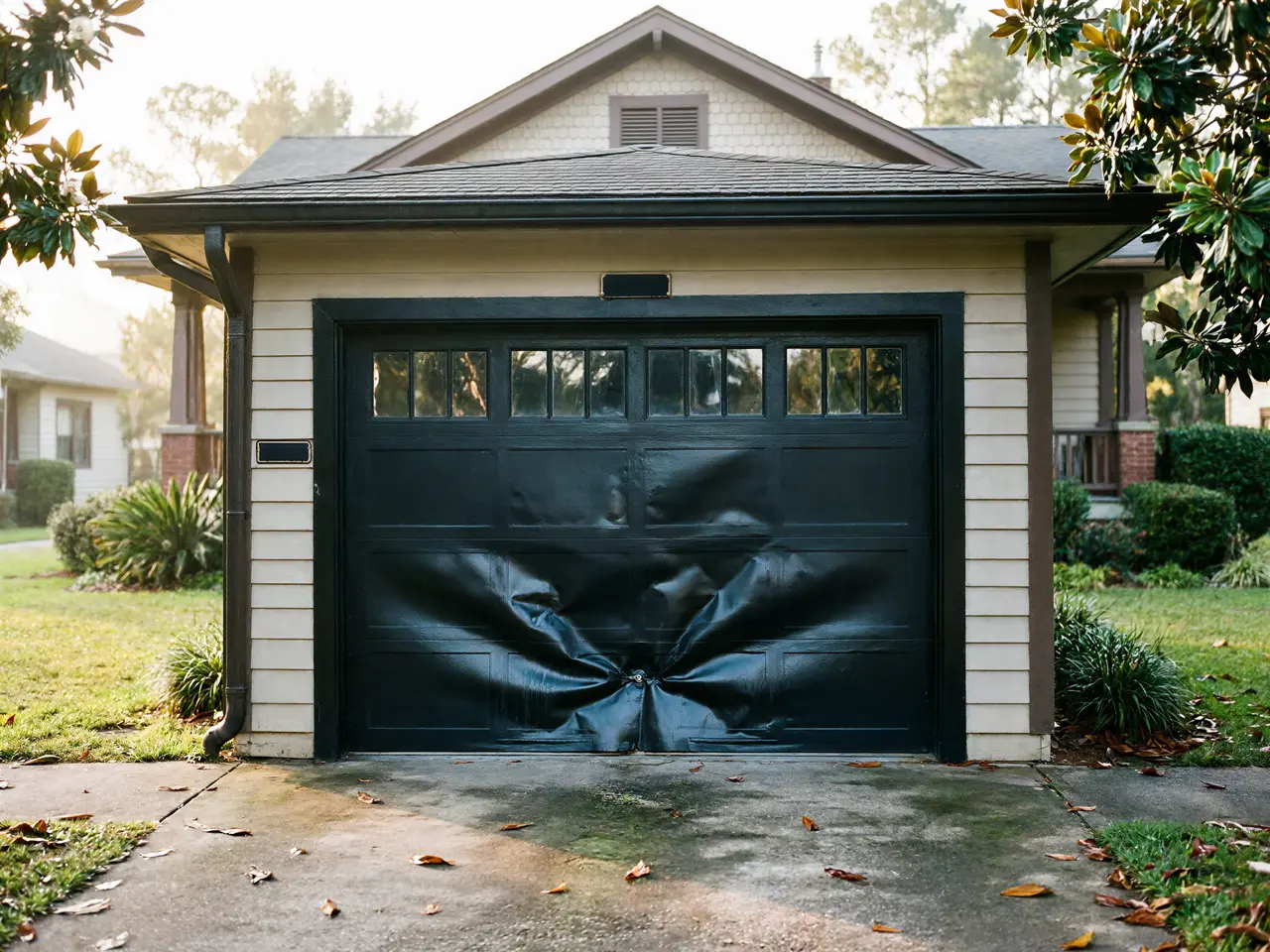
The most obvious version is a dent or a crease you can see from the driveway - a bumper hit, a basketball, a trailer backed in wrong. That's the easy call: one panel, one replacement, done.
Less obvious is a bottom panel that's gone soft or started rusting from the inside out. On houses from the 1938-2002 range, the bottom panel sits closest to grade, and over enough winters of freeze-thaw moisture, rust can eat through from the back side before it ever shows on the painted face. You'll usually catch it first as a slight bow, or a spot where the weatherstrip doesn't seat flush anymore.
On wood and wood-composite doors from the 1980s stock that's common across this area, the symptom is different again - the skin separates from the core along a seam, and the panel starts to look slightly warped or wavy under raking light, even with no impact at all.
Sometimes it's quieter than any of that: the door binds or grinds in one spot on its way up or down, and when you look closely, one panel has swollen or shifted just enough to crowd the track. That's a panel problem wearing a track problem's clothes, and it's worth having someone check before you assume it's the rollers.
How Long You Are Without the Door
If your door is a common current model and the dealer stocks the matching panel, a single-panel swap is usually a same-visit job - out, in, adjusted, done. That's the best case.
The timeline stretches when the door is old enough that the original manufacturer has discontinued that panel profile, which is common on houses from the earlier end of this area's 1938-2002 build range. At that point we're either sourcing a close match from a different run and blending the color, or ordering a custom-cut panel, and either of those adds lead time that's out of our hands once the order's placed.
Wood and wood-composite panels add their own wait, since those are often special-order regardless of the door's age - there isn't a stock shelf of them the way there is for steel.
We won't quote a one-visit turnaround on something we haven't confirmed is in stock, because telling you a date we can't hit is worse than telling you the real one. What we can tell you up front is whether your damage is a one-panel job or something closer to a full door replacement - across a service area where the median household income runs $58,594, that distinction is usually the first question people ask, and it's a fair one.
Frequently asked questions
Can you replace just the bottom panel instead of the whole door?
Usually yes, if the rest of the door and the track are sound. The bottom panel takes the most abuse - ground moisture, curb hits, backing in - so it's the one we replace most often on its own. We'll check the hinges and track alignment at the same time, since a bad bottom panel sometimes points to a hinge that's worn out too.
Will a new panel match the rest of my old door?
Color match is the easy part. Profile match is harder on older doors, since panel ribbing and height have changed across manufacturers and decades. On doors from this area's 1980s-era stock, we sometimes have to source a close-match panel and blend it rather than find an exact discontinued match.
Is panel replacement cheaper than a full door?
Generally, yes, for one or two damaged sections. It stops making sense once three or more panels are damaged, or once the track and springs are showing their age too - at that point a full door often costs about the same and you're not stuck matching old panels again in five years.
What if the panel I need isn't made anymore?
We order a close match from current production and blend color and trim where needed, or source a custom-cut panel. Either route takes longer than a stocked replacement, since it depends on the supplier's lead time, which is outside anything we control once the order is placed.
Related services
By Neighborhood
Panel Replacement across the Covington area
We also handle panel replacement in these Covington-area suburbs.
Book garage door service in Covington
Call now or request a quote - tell us what the door is doing and where you are.